First published in 1963, Cat's Cradle was the first novel to bring Kurt Vonnegut to the attention of wider audiences, even though it would take several years to achieve that popularity.
Though Vonnegut disdained the "science fiction" label, this is a book which is firmly rooted in the realm of science, and much of its technological inspiration is drawn from the author's time as a public relations agent at the General Electric complex in Schenectady, NY (which he'd transform into the fictional city of Illium). At G.E., scientists were hired to do "pure research" — i.e. to work on whatever pet projects might interest them — and Vonnegut's job was to interview them in search of human interest stories. One scientist in particular, Nobel Prize-winner Irving Langmuir, would serve as the foundation of Dr. Felix Hoenikker, who sets the novel's action in motion.
Aside from science, the other main force driving the novel is faith, in the form of the fictional religion Bokononism, through which Vonnegut is able to trace the role of religion in society and the balance between church and state. The University of Chicago turned down Vonnegut's original master's thesis in Anthropology, but years later, in 1971, they'd award him his degree on the strength of Cat's Cradle as an anthropological investigation. To keep some of the Bokononist terms straight, you might want to check out the Wikipedia page on Bokononism.
Here's the reading schedule for the novel:
Monday, February 2nd: Ch. 1, "The Day the World Ended," to Ch. 66, "The Strongest Thing There Is"
Wednesday, February 4th: Ch. 67, "Hy-u-o-ook-kuh," to Ch. 94, "The Highest Mountain"
Friday, February 6th: Ch. 95, "I See the Hook," to Ch. 127, "The End"
I hope you all enjoyed our snow day, and that you're all safe and warm with power and without dented automobiles. I've been divided as to how we should proceed, but I think the best course of action is to keep to the schedule as we currently have it, wrapping up Slaughterhouse-Five tomorrow, and if necessary carrying our discussion over into the start of Cat's Cradle on Monday.
The reason I want to do this is that it'll keep us on schedule to finish our unit on Robert Coover on the day that his Kelly Writers House fellowship begins (which means you'll be able to watch his reading and discussion having spent two weeks digesting his work). If it becomes clear that we need to reshuffle things a bit, then we can certainly do so. I'll see you all tomorrow.
It looks like we'll have to wait until the morning to see whether UC will be open or closed, and I'll defer to the powers that be's judgment in that regard (though looking at the forecast, I can't imagine them thinking it'll be safe to have thousands of students commuting on icy roads and unplowed side-streets). Stay tuned to local TV, or wait for that e-mail from Greg Hand, and I'll either see you tomorrow, or on Friday.
Richard Brautigan's poem, "Karma Repair Kit: Items 1-4," (shown above as a broadside printed by The Communication Company in San Francisco — click for a larger image) seems like a fitting ending as we move on from his gentle breeziness to the very different (but no less enoyable) tone of Kurt Vonnegut. In particular, it's empty ending fits perfectly with both novels we've read (even if A Confederate General from Big Sur had multiple endings, it's still kind of no ending). The poem's reprinted more legibly below:
Karma Repair Kit: Items 1-4
1. Get enough food to eat, and eat it.
2. Find a place to sleep where it is quiet, and sleep there.
3. Reduce intellectual and emotional noise until you arrive at the silence of yourself, and listen to it.
4.
Second, here's one last wonderful bit of sixties conceptual ephemera, in the form of Brautigan's Please Plant This Book, a folio of eight seed packets with poems printed on them, which he published in 1968. You can navigate a virtual edition of this limited-edition oddity by following this link (sorry, no actual seeds included).
From Ron Silliman's blog comes news today that some enterprising Brits have written a musical based on Richard Brautigan's novel, In Watermelon Sugar, which is included in your Trout Fishing in America 3-in-1. Click here to read more about it. If you happen to be in London next month and have a few pounds to spare, you can tell us all about it.
First published in 1969, Kurt Vonnegut's Slaughterhouse-Five, or The Children's Crusade: A Duty-Dance with Death (that's its proper, full title, but we'll just call it Slaughterhouse-Five) is his sixth novel, and his eighth book altogether (counting two short story collections). While 1963's Cat's Cradle (which we'll be reading in a week) is the novel that brought him to national prominence, Slaughterhouse-Five is his magnum-opus, and the work for which he'll best be remembered.
Having started out writing far more conventional science fiction in the early 1950s, Vonnegut's style would evolve throughout the 1960s, reflecting, in no small part, his graduate studies in anthropology at the University of Chicago, to what we now recognize as his own distinctive style. Of course, you'll see a great deal of science fiction devices brought into use throughout both novels, but especially after having honed your analytical skills with two weeks of reading Richard Brautigan, I think you'll see how these tricks of the trade fit within our understanding of serious (and I use that term rather loosely) postmodern literature. Vonnegut resented his being labeled as a science fiction writer and saw it as an excuse for academics to ignore his work — a slight we'll be working to counteract over the next two weeks.
Speaking of literary tricks, however, Vonnegut was not an advocate of them in any form, and one of the things I think you'll notice is how straightforward and clear his writing is. Here's a list of tips Vonnegut gave to writers in the preface to his story collection, Bagombo Snuff Box, which delineate his general authorial ethos:
Use the time of a total stranger in such a way that he or she will not feel the time was wasted.
Give the reader at least one character he or she can root for.
Every character should want something, even if it is only a glass of water.
Every sentence must do one of two things—reveal character or advance the action.
Start as close to the end as possible.
Be a Sadist. No matter how sweet and innocent your leading characters, make awful things happen to them—in order that the reader may see what they are made of.
Write to please just one person. If you open a window and make love to the world, so to speak, your story will get pneumonia.
Give your readers as much information as possible as soon as possible. To hell with suspense. Readers should have such complete understanding of what is going on, where and why, that they could finish the story themselves, should cockroaches eat the last few pages.
Vonnegut's own experience as a WWII prisoner of war trapped in Dresden during its 1945 firebombing (read more about this horrific incident in which Alied forces leveled the city and killed between 24,000 and 40,000 people here) shaped the heart of this novel, and having finally allowed himself to write about what he witnessed in the aftermath, he would return to this event often in his later works. Up until his death just short of two years ago, Vonnegut would be an outspoken advocate against war, and the war in which we're still embroiled would inspire him to come out of retirement, so to speak, to pen his final collection of essays, 2005's A Man Without a Country.
Below, I'll paste a few audio and video links, but first, here's the reading schedule:
Monday, Jan. 26: Chapters 1-4
Wednesday, Jan. 28: Chapters 5-6
Friday, Jan. 30: Chapters 7-10
The chapters are big, making it harder to split up the reading the way I'd like to, so if you're inclined to read a little ahead of that schedule (especially over the weekend), feel free to do so.
If you follow this link, you can listen to a BBC Radio interview with Kurt Vonnegut, in which he discusses Slaughterhouse-Five, and responds to readers' questions from around the world.
Here's a ten-minute posthumous tribute to Vonnegut from the PBS series, NOW:
In this brief clip, Vonnegut discusses how he rates his novels with Charlie Rose:
Here's a short speech by Vonnegut marking the 50th anniversary of the bombing of Hiroshima:
Vonnegut appeared in this Discover Card commercial in the 1980s:
He also appeared as himself in the terrible 1980s comedy, Back to School:
Finally, if you're looking to delve deeper, and have an hour or so to spare, you can use the playlist below to watch an eight-part profile of Vonnegut from the BBC television series Arena:
Richard Brautigan's first novel is actually the second one he wrote — publishers were a little wary of the commercial potential of Trout Fishing in America at first (for reasons that may be apparent to you after reading the book), and so decided to take a chance on this (relatively) more conventional novel. Finally, Donald M. Allen (editor of the influential anthology The New American Poetry: 1945-1960, and an early member of the staff of Evergreen Review) convinced maverick publisher Grove Press (home of Henry Miller, Jean Genet, D.H. Lawrence, Albert Camus, William S. Burroughs and others) to take a chance on Brautigan, signing him to a four-novel deal. When A Confederate General From Big Sur sold less briskly than expected, they terminated the deal, forcing the writer to seek out another home for the books that would become Trout Fishing in America, In Watermelon Sugar and The Abortion.
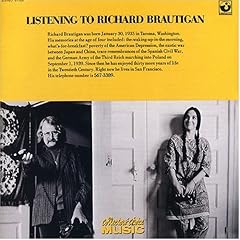
Once again, John F. Barber's site is going to be your best resource for background information on the novel. Check out his page for A Confederate General From Big Sur for contexts, reviews, covers and much, much more. Also, be sure to check out Listening to Richard Brautigan once more, since you can hear "The Rivets in Ecclesiastes," an excerpt from the novel, on that album.
Here's the reading schedule:
Week 2
Friday, Jan. 16: Front Matter, Prologue and all of Part I (up to page 48)
Week 3
Monday, Jan. 19: No Class: Martin Luther King Day
Wednesday, Jan. 21: Part II: "The Letters of Arrival and Reply" to "Wilderness Again" (51 - 108)
Friday, Jan. 23: "The Pork Chop Aligator" to "To a Pomegranate Ending, Then 186,000 Endings Per Second" (109 - 159)
On Monday, Jan. 26th, we'll begin Kurt Vonnegut's Slaughterhouse-Five.
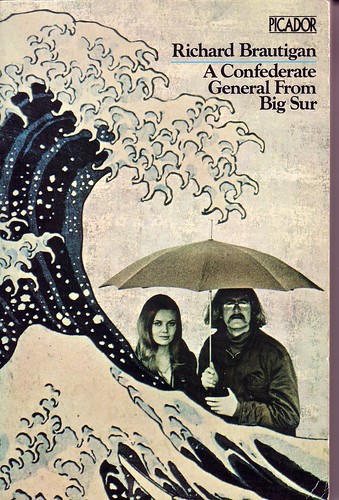
Finally, here's a rather interesting variant cover to the novel, from the 1973 Picador edition — a fine example of pre-Photoshop image manipulation:
Mr. Brautigan submitted a book to us in 1962 called TROUT FISHING IN AMERICA. I gather from the reports that it was not about trout fishing
— a representative of Viking Press, who rejected Brautigan's manuscript
It's also worth noting that, according to the Brautigan Wikipedia page:
In March 1994, a teenager named Peter Eastman Jr. from Carpinteria, California legally changed his name to "Trout Fishing in America," and now teaches English in Japan. At around the same time, National Public Radio reported on a young couple who had named their baby "Trout Fishing in America."
That's two more items for our list of all the different things "Trout Fishing in America" means.
If you follow this link, and scroll down through all of the background information, you'll be able to listen to Richard Brautigan's 1970 record, Listening to Richard Brautigan, which begins with "The Hunchback Trout," a chapter from Trout Fishing in America, which you'll be reading for Monday. The album also contains excerpts from his novels A Confederate General from Big Sur and In Watermelon Sugar, and the short story collection, Revenge of the Lawn, as well as a few dozen poems from The Pill Versus the Springhill Mine Disaster, a collection of Brautigan's poetry, which is included in your three-in-one edition. In addition to Brautigan reading his work, there are a number of tracks which take the title more literarlly: the sounds of Brautigan getting undressed, talking on the phone, and having conversations with friends while making dinner. It's worth listening to a few tracks to get a feel for his voice.
If you flip further back to take a look at some of the poems, and consider the length of the chapters in Trout Fishing in America, or a very short story like "The Scarlatti Tilt," you'll begin to sense a pattern in Brautigan's work: brief, sometimes microscopic vignettes, which work together as a whole, almost like bits of glass in a mosaic. When reading the novels, try to be mindful of both the effect of each small bit of writing on its own, and the way in which they fit alongside one another.
Our first novel of the quarter will be Richard Brautigan's Trout Fishing in America (1967), a counter-cultural masterpiece which sold more than a million copies in the late 60s. Brautigan was a transitionary figure in San Francisco's literary scene, coming a little too late for its Beat Generation heyday, and predating the Summer of Love, he helped bridge the gap between beatniks and hippies, along with authors like Allen Ginsberg, Lew Welch, Gary Snyder and Michael McClure. And yes, this is a novel, not a collection of short stories: though Brautigan's sundry vignettes and short stories might not seem like a traditional novel, he intended them to be read together as one cohesive, albeit fragmented, narrative. He'd make the same claim about his later collection, The Tokyo-Montana Express (one of my favorite Brautigan books), which is similarly comprised of numerous short prose pieces.
There's a considerable amount of background information on the novel on John F. Barber's site, The Brautigan Bibliography and Archive. Click on this link to check out his Trout Fishing in America page. Later this week, I'll also be posting audio from Brautigan's 1970 Harvest album, Listening to Richard Brautigan, which was originally supposed to be released on the Beatles' Zapple label.
Here's the reading assignments for each day we'll be looking at the novel:
Week 1
Friday, Jan. 9: "The Cover of Trout Fishing in America" to "Trout Fishing in America Terrorists" (1-40)
Week 2
Monday, Jan. 12: "Trout Fishing in America with the FBI" to "A Return to the Cover of This Book" (41-77)
Wednesday, Jan. 14: "The Lake Josephus Days" to "The Mayonnaise Chapter" (79-112)
On Friday, Jan. 16th, we'll begin A Confederate General from Big Sur.
As I final footnote, I was in San Francisco over the break for the annual MLA conference, and visited Washington Square Park, where the cover photo for Trout Fishing in America was shot. Here are a few photos of the Benjamin Franklin statue, which appears behind Brautigan on the cover, and is mentioned a few times in the novel (click on each for a larger view):
Before we begin looking at the work of Brautigan, Vonnegut, Coover and Barthelme, I want to give you some tools with which to approach the texts. My hope is that our work this quarter will operate on two levels: a more traditional analysis of the fiction itself (its plot, characters, etc.), and a meta-analysis of the characteristics which distinctly make it a product of postmodern times.
Towards that end, I'd like you to read the Wikipedia article on Postmodern Literaturefor Wednesday's class. Typically, the Wikipedia isn't considered a scholarly source, however I thought this was a very thorough overview of postmodernism's development and the key characteristics of postmodern literature, written in a fairly straightforward and understandable voice (and replete with hyperlinks so you can look up the terms and people you're not familiar with). During class, I'll hand out a one-page "cheat-sheet" with information on most of the ideas you'll need to have at hand throughout the quarter.
Additionally, I'm posting links to four short stories which I'd like you to read as well. These will serve as "test cases" during Wednesday's discussion, though feel free to think of other examples you're more familiar with that illustrate the characteristics of postmodernism.
clockwise, from top left: Richard Brautigan, Robert Coover, Kurt Vonnegut and Donald Barthelme
ENGL 202 – 002: Topics in Literature: Early American Postmodern Fiction
We’ll start with a theoretical consideration of postmodernism and its cultural implications, before spending most of the semester examining the work of a quartet of authors who made great strides towards a particularly American postmodernism in the 1960s and 70s: Donald Barthelme, Richard Brautigan, Robert Coover and Kurt Vonnegut. Coursework will include both critical evaluations of the texts considered, as well as creative experiments within forms established by the authors.
Attendance/Lateness: Attendance and punctuality are mandatory. Since our work will largely consist of group discussion, missing (or arriving late for) a class can have serious and detrimental effects on your overall performance. You will automatically fail the class if you exceed five absences, though any missed classes will likely have adverse affects on your final grade. Please note that absences are absences—sick days (with or without a doctor’s note) are no different than days that you don’t feel like getting out of bed—and the only exception to this rule will be when classes are officially cancelled due to inclement weather. The attendance policy for this class will be strictly enforced. Please show respect and courtesy to your peers by arriving to each class on time.
Participation: Because so much of our work this semester will be collaborative, participation—both in the classroom and on the course blog—is vital and necessary. Freely and comfortably sharing your insights, opinions and perspectives (as well as your questions) will be an invaluable part of our fuller understanding of the texts we’ll examine. For this reason, class participation constitutes a full 15% of the final grade. Do not underestimate the importance of this percentage: a zero can have disastrous effects upon your performance.
Course Blog: In lieu of Blackboard, I’ll be using this blog to make announcements, distribute handouts as PDFs, and share supplementary materials—including useful links, podcasts and MP3 recordings, as well as YouTube videos—which will help to broaden your class experience this semester. It’s in your best interest to check the blog one a daily basis, and to simplify that process, I’ve added links in the sidebar which will allow you subscribe to the blog’s xml feed through your preferred feed aggregator (iGoogle, Google Reader, etc.), or sign up to receive e-mail updates via FeedBurner when new posts are added.
I’d like this blog to be a useful venue for students to discuss our readings, ask questions and share links via the comments section. Please be sure to include your full name at the bottom of your message when posting a comment. Regular activity on our course blog can only help your class participation grade.
Quizzes: Over the course of the semester, you can expect a number of short, unannounced quizzes—approximately one per week, or one per author/text—which will serve as a measure of your reading comprehension and retention. Missed quizzes cannot be made up, and will aversely affect your final grade. A hint: we’re far less likely to have a quiz if the class is having a lively and engaged conversation about the day’s readings.
Technology: In theory, technology is a wonderful thing, but in the classroom, it can be a distraction. Please make sure that your cell phone is turned off (or at the very least in silent mode) before class begins, and keep it in your bag throughout. Texting during class will not be tolerated, and if done during a quiz or exam, will be presumed to be cheating (with appropriate consequences). Finally, the use of laptops for note-taking during class is a privilege, not a right—if I believe you're using your laptop to check e-mail, surf the internet or play solitaire during class, you'll be forbidden from using it for the rest of the quarter.
Communication: Please make use of my posted office hours, the time before and after class and e-mail to discuss your performance in the course, pose questions you might have, etc. If you're having trouble, doing poorly on quizzes or just not getting the readings, it's better to ask for help sooner rather than later. Unofficially, you should meet with me at least once during the quarter.
Plagiarism: At this stage of your academic career, you are probably well-acquainted with UC’s Academic Honesty Policy and Student Code of Conduct, however after the winter break, it might be advantageous to re-orient yourself with those policies now, as you start your classes.
Plagiarism, defined as “the appropriation of information, ideas, or the language of other persons or writers and the submission of them as one's own to satisfy the requirements of a course,” can take many guises, including cheating on a quiz, cutting-and-pasting information found on the web, failing to properly cite sources or fabricating them entirely. Any student found guilty of plagiarism, in any form, will automatically fail this course. Disciplinary action will also result, including an official record of this offense, potentially affecting your academic future.
The Writing Center:The Writing Center is a valuable and free resource available to all UC students. Writing Fellows are available to help students at all stages of the writing process from brainstorming to drafting, as well as with editing essays. I strongly encourage you to have a tutor review all the writing you do for this course. Please visit their website for hours of operation, writing resources and more information.
Special Needs Statement: If you have any special needs related to your participation and performance in this course, please speak to me as soon as possible. In consultation with Disability Services, we can make reasonable provisions to ensure your ability to succeed in this class and meet its goals.
Final Grade: Your final grade will be calculated according to the following percentages:
Midterm Exam: 25%
Final Essay: 35%
Quizzes: 25%
Class Participation: 15%
Paper Format: All worked handed in for this class must be typed, double-spaced, and MUST be stapled. Use 12-point, Times New Roman font for each assignment, and be sure to use the MLA header. Late work will be penalized, losing a full letter grade for each class missed. If you will miss a class when an assignment is due, you can drop it off in my mailbox or at my office beforehand, or have a friend bring it to class. I will not accept work via e-mail. Any divergence from this policy will be done solely at my discretion.
This quarter, we'll be reading a total of eight books: a pair from each of four authors. We'll be covering them in this order, starting with Richard Brautigan, so please be sure you've purchased the books in time for our class discussions.
Richard Brautigan
Trout Fishing in America
A Confederate General from Big Sur
(Most of Brautigan's books are only commercially in print in a series of three-in-one volumes, but used copies of these individual books abound. Either version is fine.)
Kurt Vonnegut
Slaughterhouse-Five, or The Children's Crusade: A Duty-Dance with Death
Cat's Cradle
Robert Coover
Pricksongs and Descants: Fictions
The Universal Baseball Association, Inc., J. Henry Waugh, Prop.
Donald Barthelme
Sixty Stories
The Dead Father
(Please don't confuse Sixty Stories with the similarly-titled collection, Forty Stories. Also, you don't necessarily need the new reissue with the introduction by David Gates)
Books have been ordered at both the UC and DuBois Bookstores. You can also find used copies from sites including Small Press Distribution, Powell's,Alibris, ABE Books and Half.com, as well as sellers on Amazon and Barnes & Noble.
After a brief theoretical introduction to postmodernism and its literary characteristics in our second class, we'll divide the quarter into four two-week units, each focused on one author. The readings will be supplemented with additional materials posted on the blog, including interviews and other texts, as well as recordings and/or videos.
We'll also have the rare and exciting opportunity to take part in the webcast of Robert Coover's reading (on the evening of Monday, Feb. 23rd) and his question-and-answer session with Al Filreis (on the morning of Tuesday, Feb. 24th), both part of his visit as one of this year's Kelly Writers House Fellows at the University of Pennsylvania. As we get closer to the date, we'll discuss logistics for taking part in those events.
Week 1
Monday, Jan. 5: Introductions, syllabus, course outline and goals for the quarter
Wednesday, Jan. 7: background readings and a few test cases
Friday, Jan. 9: Richard Brautigan, Trout Fishing in America, day 1
Week 2
Monday, Jan. 12: Richard Brautigan, Trout Fishing in America, day 2
Wednesday, Jan. 14: Richard Brautigan Trout Fishing in America, day 3
Friday, Jan. 16: Richard Brautigan, A Confederate General from Big Sur, day 1
Week 3
Monday, Jan. 19: No Class: Martin Luther King Day
Wednesday, Jan. 21: Richard Brautigan, A Confederate General from Big Sur, day 2
Friday, Jan. 23: Richard Brautigan, A Confederate General from Big Sur, day 3
Week 4
Monday, Jan. 26: Kurt Vonnegut, Slaughterhouse-Five, day 1
Wednesday, Jan. 28: Kurt Vonnegut, Slaughterhouse-Five, day 2
Friday, Jan. 30: Kurt Vonnegut, Slaughterhouse-Five, day 3
Week 5
Monday, Feb. 2: Kurt Vonnegut, Cat's Cradle, day 1
Wednesday, Feb. 4: Kurt Vonnegut, Cat's Cradle, day 2
Friday, Feb. 6: Kurt Vonnegut, Cat's Cradle, day 3
Week 6
Monday, Feb. 9: Midterm Exam
Wednesday, Feb. 11: Robert Coover, Pricksongs and Descants, day 1
Friday, Feb. 13: Robert Coover, Pricksongs and Descants, day 2
Week 7
Monday, Feb. 16: Robert Coover, Pricksongs and Descants, day 3
Wednesday, Feb. 18: Robert Coover, The Universal Baseball Association . . ., day 1
Friday, Feb. 20: Robert Coover, The Universal Baseball Association . . ., day 2
Week 8
Monday, Feb. 23: Robert Coover, The Universal Baseball Association . . ., day 3
 First published in 1963, Cat's Cradle was the first novel to bring Kurt Vonnegut to the attention of wider audiences, even though it would take several years to achieve that popularity.





 Posts
Posts

