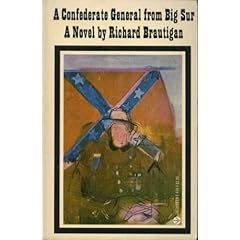
 Richard Brautigan's first novel is actually the second one he wrote — publishers were a little wary of the commercial potential of Trout Fishing in America at first (for reasons that may be apparent to you after reading the book), and so decided to take a chance on this (relatively) more conventional novel. Finally, Donald M. Allen (editor of the influential anthology The New American Poetry: 1945-1960, and an early member of the staff of Evergreen Review) convinced maverick publisher Grove Press (home of Henry Miller, Jean Genet, D.H. Lawrence, Albert Camus, William S. Burroughs and others) to take a chance on Brautigan, signing him to a four-novel deal. When A Confederate General From Big Sur sold less briskly than expected, they terminated the deal, forcing the writer to seek out another home for the books that would become Trout Fishing in America, In Watermelon Sugar and The Abortion.
Once again, John F. Barber's site is going to be your best resource for background information on the novel. Check out his page for A Confederate General From Big Sur for contexts, reviews, covers and much, much more. Also, be sure to check out Listening to Richard Brautigan once more, since you can hear "The Rivets in Ecclesiastes," an excerpt from the novel, on that album.
Here's the reading schedule:
Week 2
- Friday, Jan. 16: Front Matter, Prologue and all of Part I (up to page 48)
Week 3
- Monday, Jan. 19: No Class: Martin Luther King Day
- Wednesday, Jan. 21: Part II: "The Letters of Arrival and Reply" to "Wilderness Again" (51 - 108)
- Friday, Jan. 23: "The Pork Chop Aligator" to "To a Pomegranate Ending, Then 186,000 Endings Per Second" (109 - 159)
On Monday, Jan. 26th, we'll begin Kurt Vonnegut's Slaughterhouse-Five.
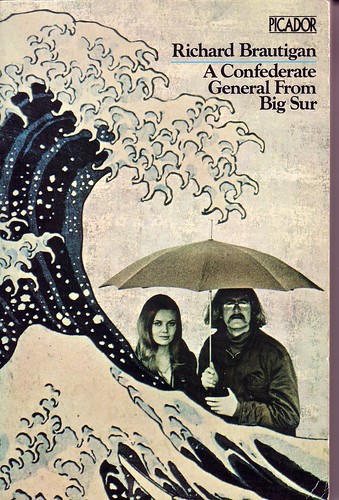
Finally, here's a rather interesting variant cover to the novel, from the 1973 Picador edition — a fine example of pre-Photoshop image manipulation:


 Posts
Posts


I reviewed A Confederate General from Big Sur for my online literary blog Innovative Fiction Magazine. I think this novel is worth considering in the context of the classroom, with a few literary references that show it is written by a novelist/poet who is charming as a narrator, with an informal style that is part of the American trend in dialogue. A cool classic from the 1960s!
ReplyDelete